
Your Payroll Spreadsheet Is Costing You More Than You Think

Most small businesses in The Gambia run payroll on a spreadsheet. Someone who understood it built it years ago, it gets copied forward every month, and it mostly works. It also costs nothing, which is exactly why nobody questions it.
But a payroll spreadsheet does have costs. They just never show up in a cell. Here are five of them, and what the same month looks like when payroll is not a spreadsheet.
1. The formula nobody has checked since it was written
PAYE in The Gambia has six bands, and a spreadsheet formula that handles them properly is long and fragile. It gets written once and trusted forever. The trouble is that the bands do not stay still.
In the 2025 national budget the tax-free amount went up from D24,000 a year to D36,000. If your sheet was never updated, it has been taking too much tax from your staff ever since: D250 a month from everyone earning more than D6,333 a month, and D175 a month from someone on D5,000. Nobody notices, because the formula still produces a number and the number looks reasonable. You can check any salary against the current bands with our free PAYE calculator.
The same kind of error creeps in every time a row is inserted outside a total's range, a one-off bonus is copied into next month by mistake, or somebody types a figure over a formula to "fix" one cell. Each one is small. Each one repeats every month until someone finds it.
2. The one person who knows how it works
In most businesses, one person really understands the payroll sheet. When they are sick on payday, travelling, or leave the business, payroll becomes a guessing game: which columns are formulas, which were typed in by hand, and why a column halfway across is hidden.
That is a real risk to the business. Salaries are the one payment your whole team notices when it is late.
3. The payslips nobody gets
A spreadsheet works out the numbers, but it does not hand every employee a payslip. So most staff paid from a spreadsheet never get one, or get a handwritten note of the total.
That matters twice over. Under the Labour Act 2023, every payment of wages must come with an itemised statement showing gross pay, each deduction and net pay. And an employee who cannot see how their pay was worked out comes to ask, usually the week the figure changes. Each of those conversations takes time and chips away at trust, even when the pay was right.
4. Payday takes days, not hours
Add up the real work behind a spreadsheet payroll: collecting the month's changes, updating the sheet, checking it, typing the bank transfer list, writing payslips, preparing the PAYE schedule for GRA and the SSHFC figures, and then entering the totals again in your accounts.
None of it is difficult. All of it is manual, all of it happens every month, and most of it is the same as last month.
5. No history you can trust
A spreadsheet can be changed after payday without anyone knowing. When a former employee asks what they were paid in March, or SSHFC asks about a contribution, the answer depends on which copy of the file you open, and whether anyone changed it since.
The same month without the spreadsheet
To show the difference, we set up a demo business in Jokoor Payroll: Kombo Furniture, with eight staff across a showroom in Westfield and a workshop in Sukuta. Everything in the screenshots below is the real product.
Set up once
Each employee's details are entered once: bank account, TIN, SSHFC number and the pay structure that sets their basic salary and allowances. You can import them from an Excel sheet, so the spreadsheet you already have becomes the starting point rather than wasted work.
Payroll day
On the payroll day you choose, Payroll creates the month's pay run by itself, with a payslip for every active employee and PAYE and SSHFC already worked out on the current tax bands. When the bands change, we update Payroll. Nobody has to go looking for a formula.
You add what is different this month, such as overtime or an advance being repaid, straight onto the draft payslip or from an Excel sheet, and approved unpaid leave comes off automatically. Then you check the whole month on one screen. Kombo Furniture's September comes to GMD 85,900 of gross pay and GMD 69,361.62 to pay out, and the Taxes and Deductions tab shows the rest of what the month costs:
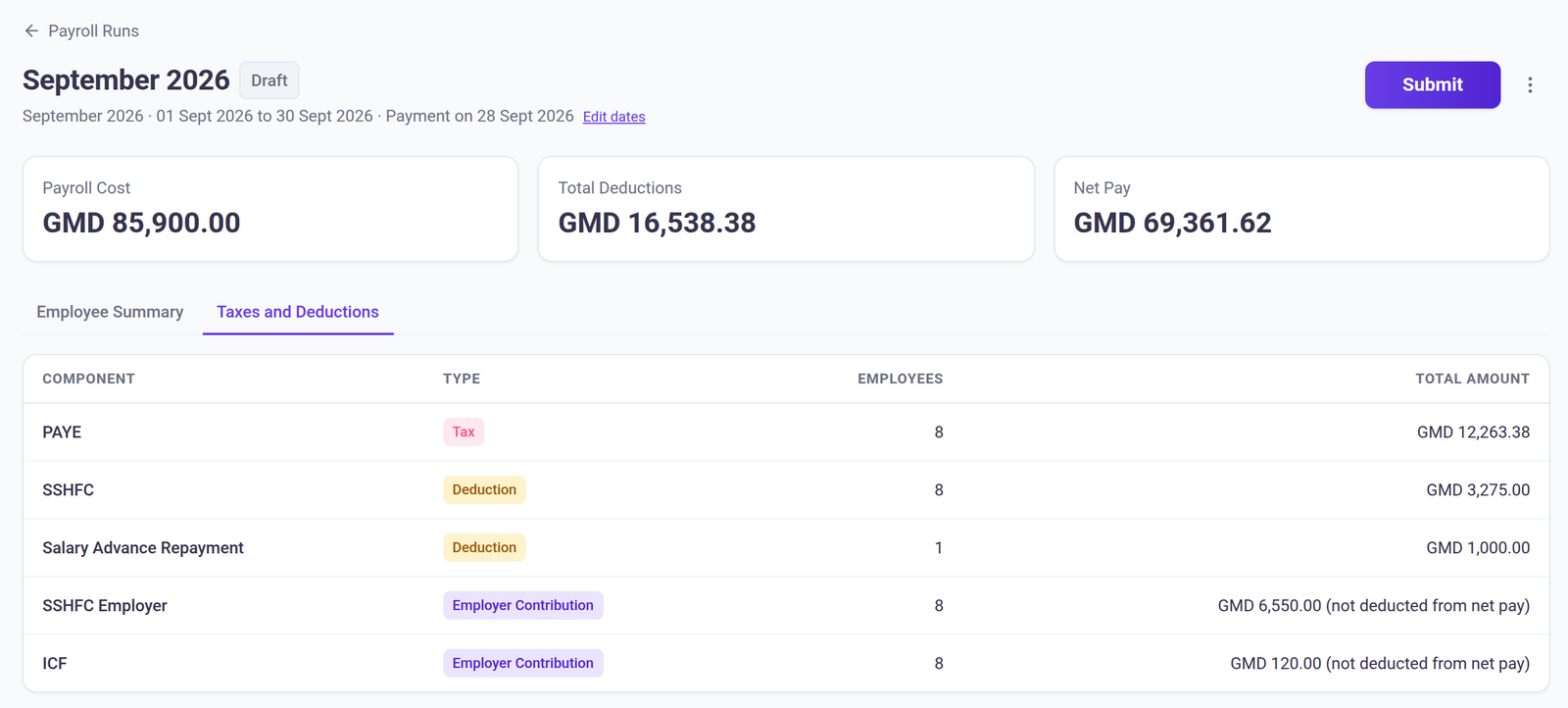
GMD 12,263.38 of PAYE for GRA, GMD 3,275 taken from staff for SSHFC, and GMD 6,670 the business pays on top for employer SSHFC and the injuries fund. That last figure is the one a spreadsheet most often forgets, because it never appears on anyone's pay.
Submit, and it locks
When the figures are right, you press Submit. The payslips become final and the run locks, so September cannot quietly change after it has been paid. Past pay runs stay in the list exactly as they were submitted.
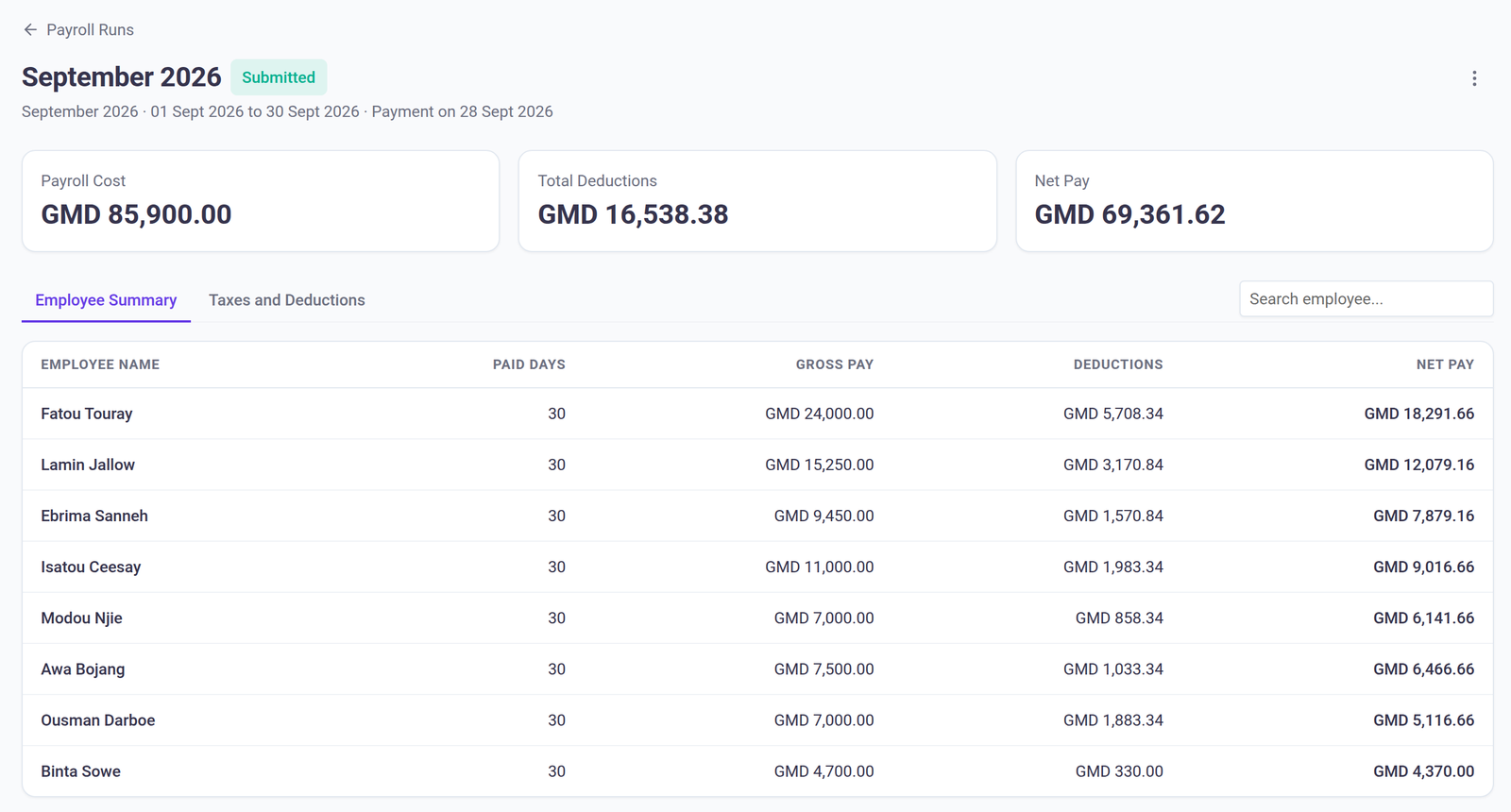
Every employee gets a payslip
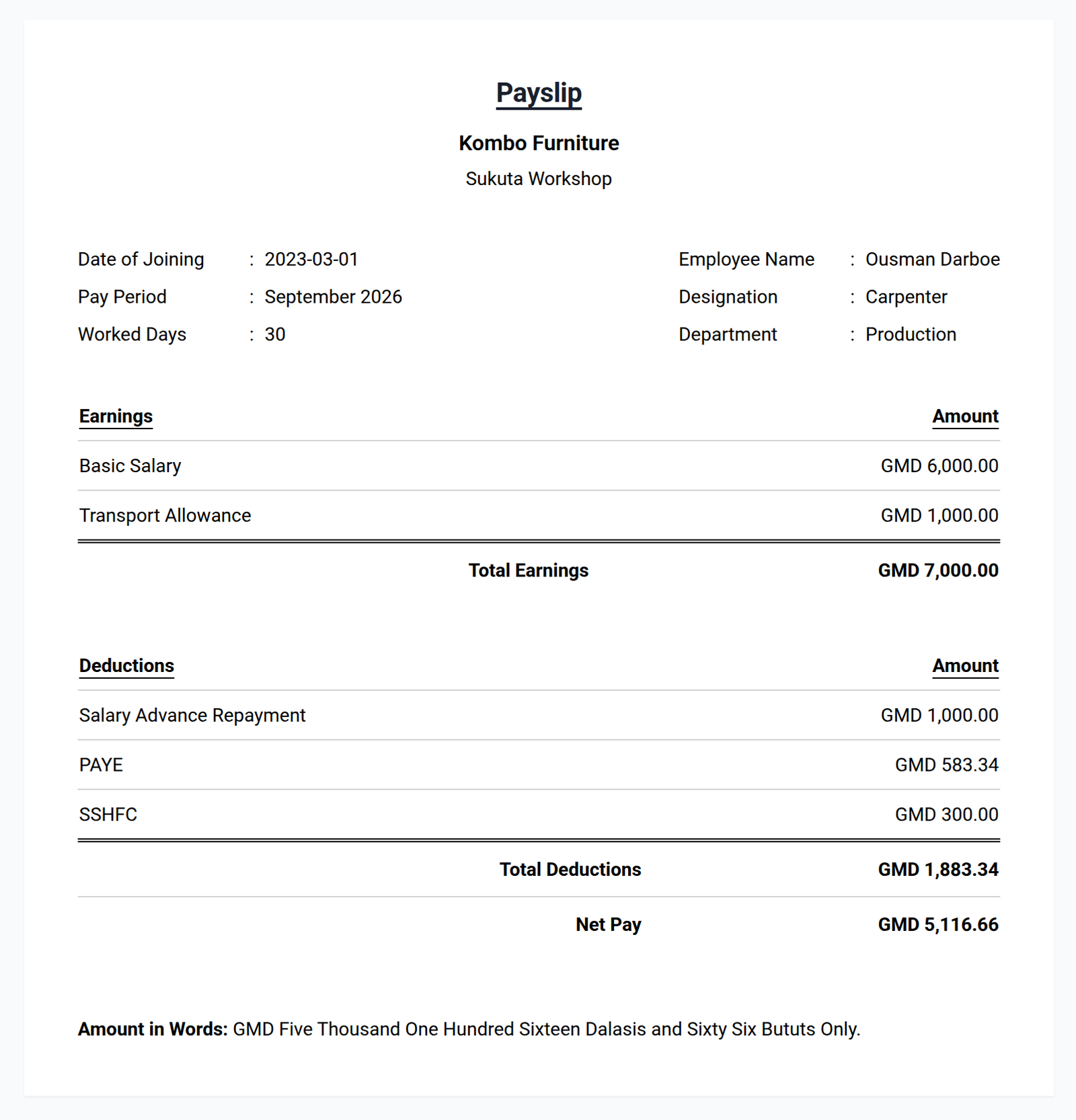
Every payslip shows each earning and each deduction. Ousman, a carpenter, is repaying a D1,000 salary advance this month, and his payslip shows it on its own line, so there is nothing to explain when his pay is lower:
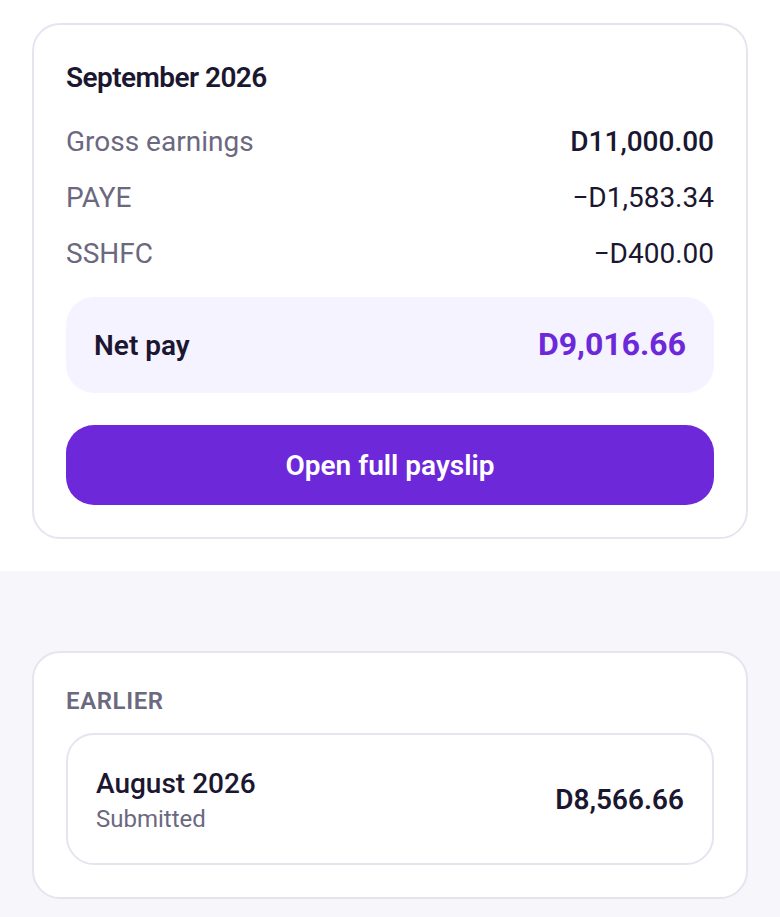
With payslip texts switched on, each employee gets an SMS with a link to their own payslip as soon as the run is submitted. Staff can also sign in on their phone with their number and a code sent by SMS, and see every payslip they have had:
Everything after payday is ready too
Payroll gives you the bank sheet in Excel for the salary transfers, a PAYE report for GRA and an SSHFC contribution report, both of which export to Excel. With the Books connection switched on, one action posts the month's salaries to your accounts in Jokoor Books.
What it adds up to
Payroll day stops being a spreadsheet job. The tax bands are kept current for you, a submitted month cannot change behind your back, every employee has a payslip, and the figures for GRA and SSHFC come from the same numbers rather than being worked out a second time.
You can see it at Jokoor Payroll. If you would rather someone set it up with you, spreadsheet and all, call us on +220 2023700. And for the rules behind each step, from the PAYE bands to the 15th of the month deadline, read our guide on how to run payroll in The Gambia.