
Why Your Books Are Always Three Months Behind
Ask most business owners in The Gambia whether they made money last month and the honest answer is: we will know when the accountant has been through it. The receipts go into a bag or a drawer, the bank statements pile up unopened, and at the end of the year somebody spends a week turning all of it into a set of accounts. By then the year is over. Whatever the numbers say, it is too late to act on them.
Being three months behind is not a character flaw. Almost every business ends up there, for one simple reason: recording is treated as a separate job that happens later, after the real work. And later always loses to today.
Why the books fall behind
A sale happens at the counter. The money arrives by transfer, by mobile money, sometimes in cash. The receipt gets written, or it does not. Weeks later someone sits down to enter it all, and now they are working from memory and from paper that has been folded, lost or never existed.
Three things go missing in that gap, every time.
- Costs nobody wrote down. The bank takes its monthly fee. The landlord is paid by standing order. Nobody raises a receipt for either, so neither reaches the books.
- Money that arrived without paperwork. A cash sale deposited on a Friday, a customer paying a balance by transfer with no invoice number in the reference.
- Who still owes you. When invoices live in a book or a WhatsApp chat, nobody can say on a given morning which customers have paid and which have not.
None of this needs more discipline. It needs the recording to happen at the moment money moves, and it needs something to check your books against the one record that is never wrong: your bank statement.
To show how that works we set up a demo business in Jokoor Books: Kombo Furniture, a showroom and workshop at Westfield, with August and September of ordinary trading. Everything in the screenshots below is the real product.
Record the sale when it happens
The single biggest change is invoicing at the moment of the sale rather than at the end of the month. The invoice takes a minute to raise while the customer is still in front of you, and from then on the books know three things without anyone remembering them: what was sold, to whom, and whether it has been paid.
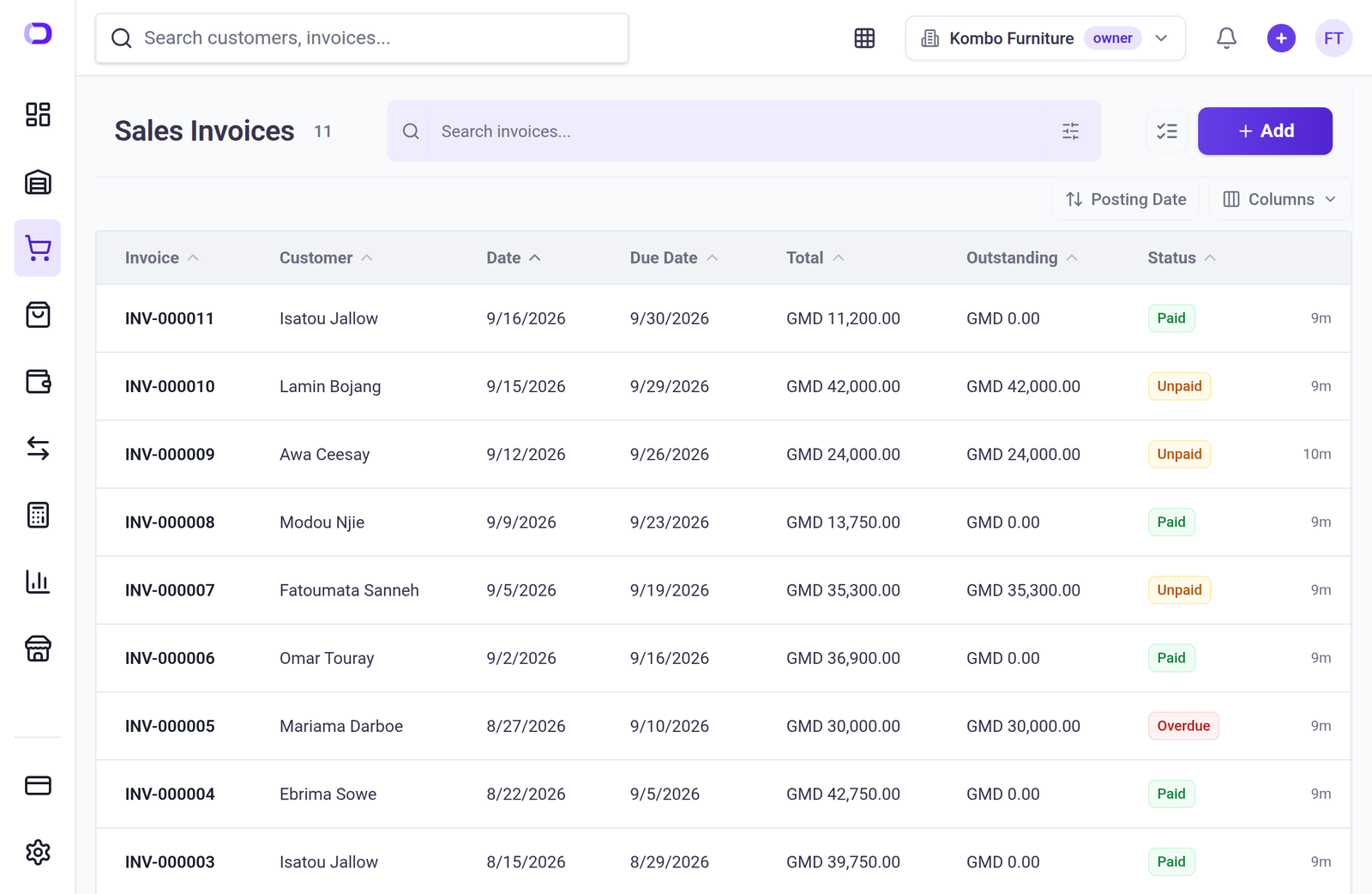
That list answers the question most owners cannot answer on a normal Tuesday. Kombo Furniture is owed GMD 131,300 across four invoices, and one of them, GMD 30,000 from Mariama Darboe, is past its due date. That is a phone call worth making today, not a surprise to discover in December.
When a payment arrives, it is recorded against the invoice it belongs to, and the status changes on its own. Sales rung through Jokoor POS land in Books automatically, and so do payments collected through Jokoor Pay, so the busiest parts of the day need no separate entry at all.
Let the bank statement check your books
This is the step that turns a set of books you hope is right into one you know is right. It is called bank reconciliation, and it means comparing every line on your bank statement with what your books say happened.
Done by hand, it is the job everyone postpones. In Books you download your statement from internet banking as a CSV file, import it, and press Auto-Reconcile. Books then matches each line on the statement to the payment it already has on record.
For Kombo Furniture's thirteen statement lines across August and September, it matched ten on its own:
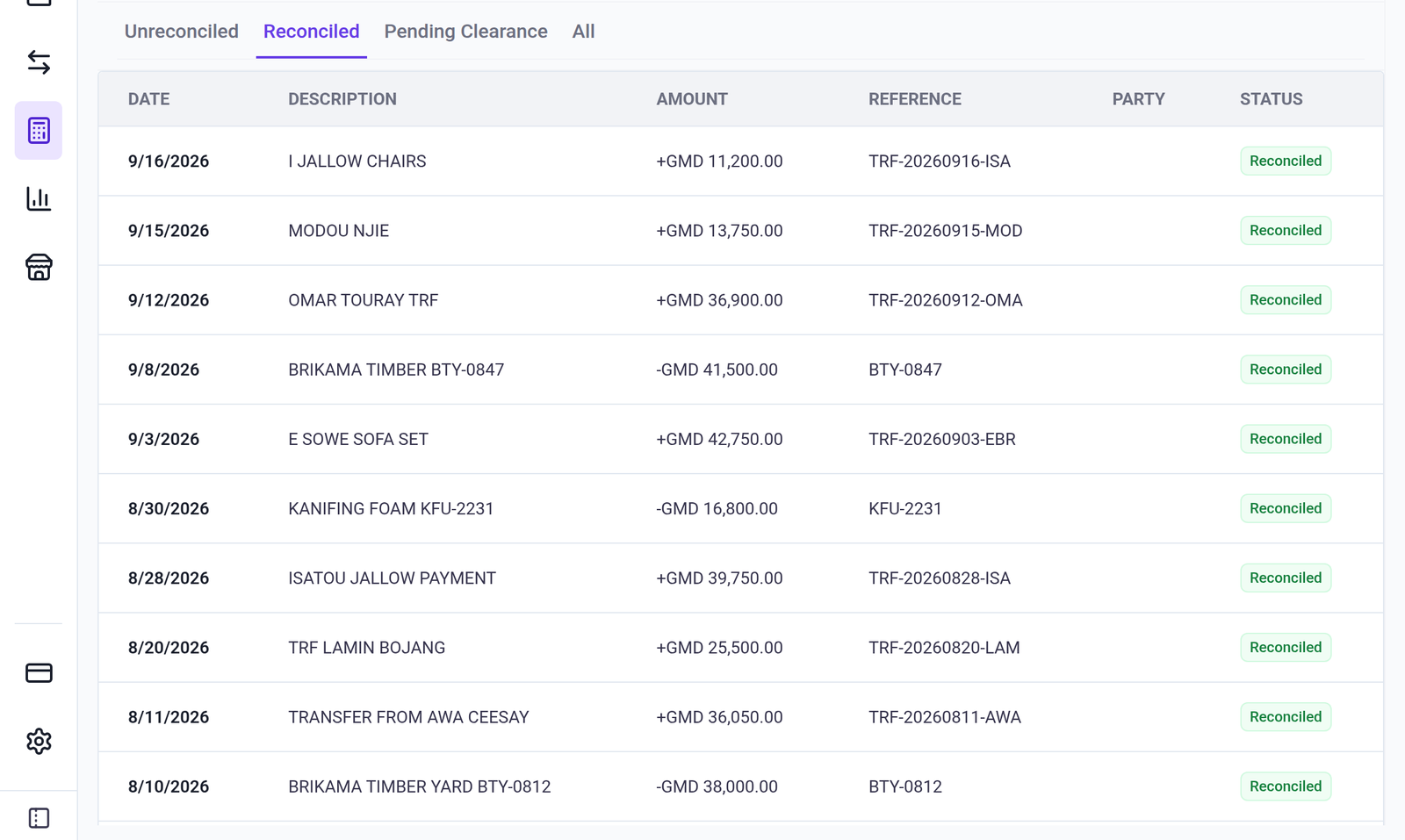
Every customer transfer and every supplier payment that had been recorded found its match without anyone ticking a box. The interesting part is what is left over.
The lines that are left are the ones that matter
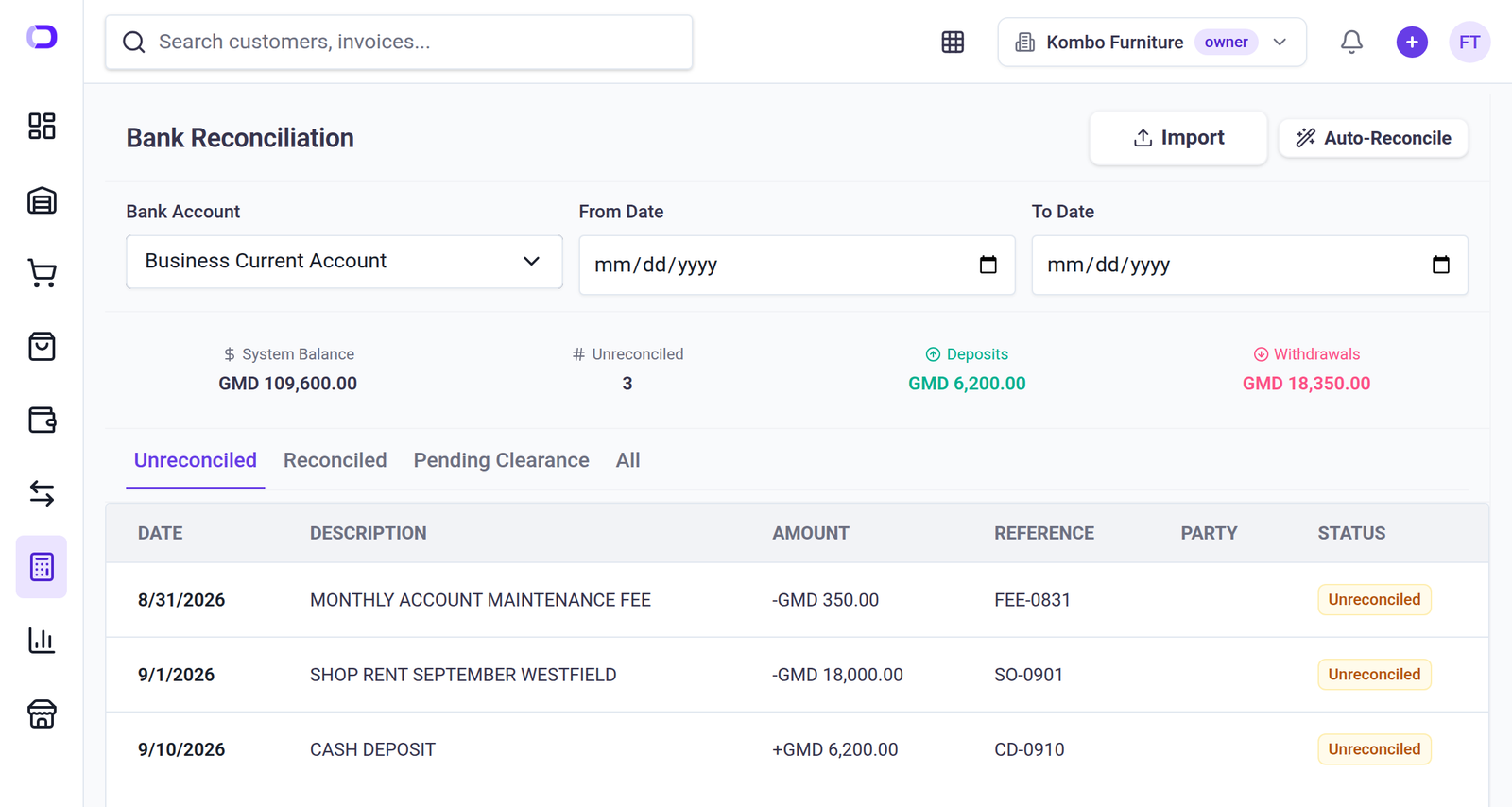
Three lines did not match anything, and they are exactly the three kinds of thing that make books wrong:
- A GMD 350 account maintenance fee the bank took at the end of August.
- GMD 18,000 of shop rent for September, paid by standing order.
- A GMD 6,200 cash deposit that is money from a sale nobody invoiced.
Without the statement, rent and bank fees would simply be missing, and the profit figure would be GMD 18,350 higher than the truth. That is the kind of error that is invisible in a spreadsheet and obvious here.
Fixing each one takes a few seconds from the same screen. Open the line, Books confirms there is nothing in the books that matches it, and you record what it was:
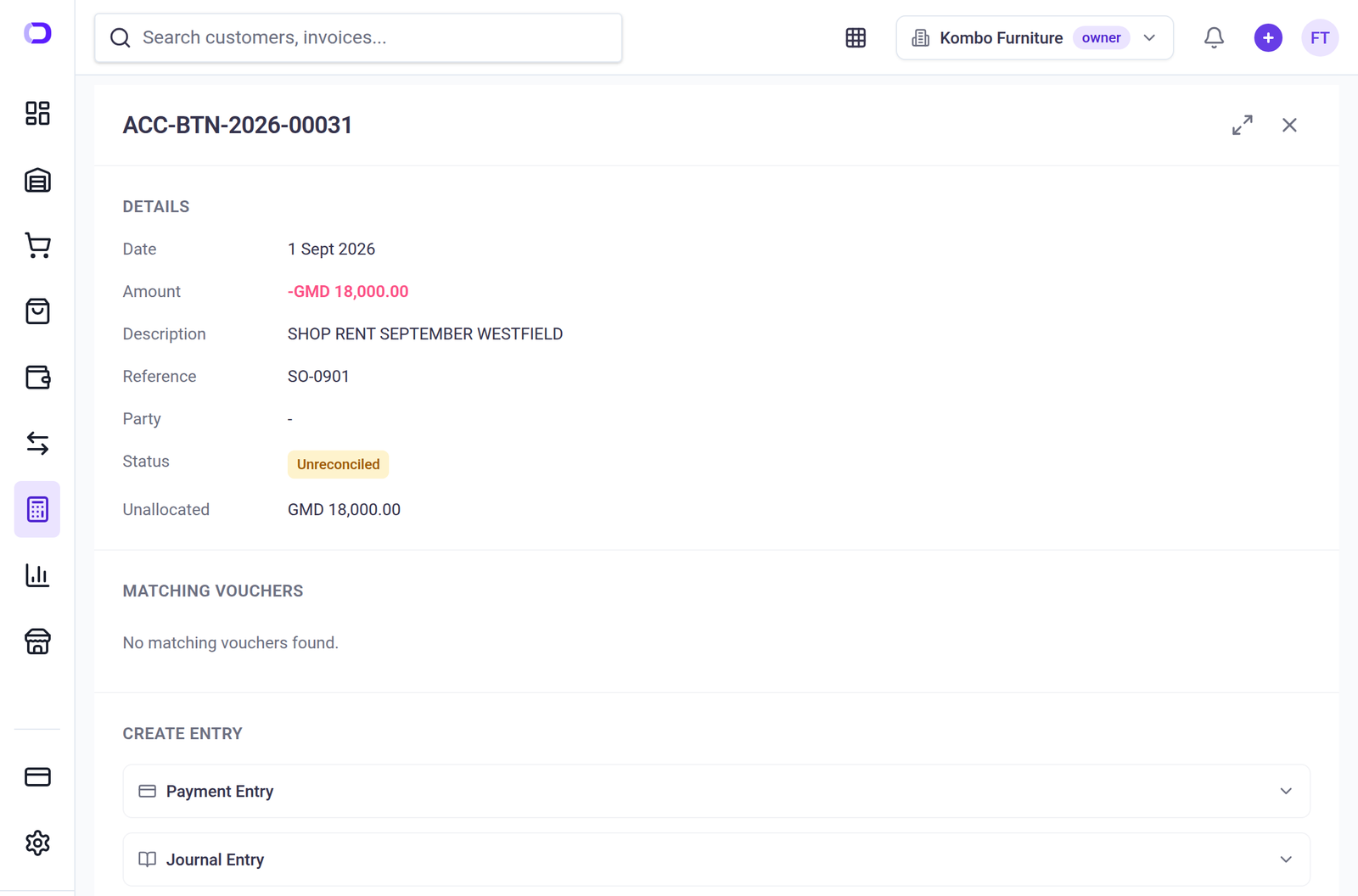
The rent goes to the rent account, the bank fee to an expense account, and both lines disappear from the unreconciled list. The cash deposit stays on the list until someone works out which sale it was. That is not a failure. It is the list doing its job: telling you precisely what you still do not know, instead of letting it vanish into the year-end total.
Profit on any day, not once a year
Once sales are recorded as they happen and the bank has checked the rest, the reports stop being a year-end project. They are simply correct, today. Here is Kombo Furniture's profit and loss for August and September:
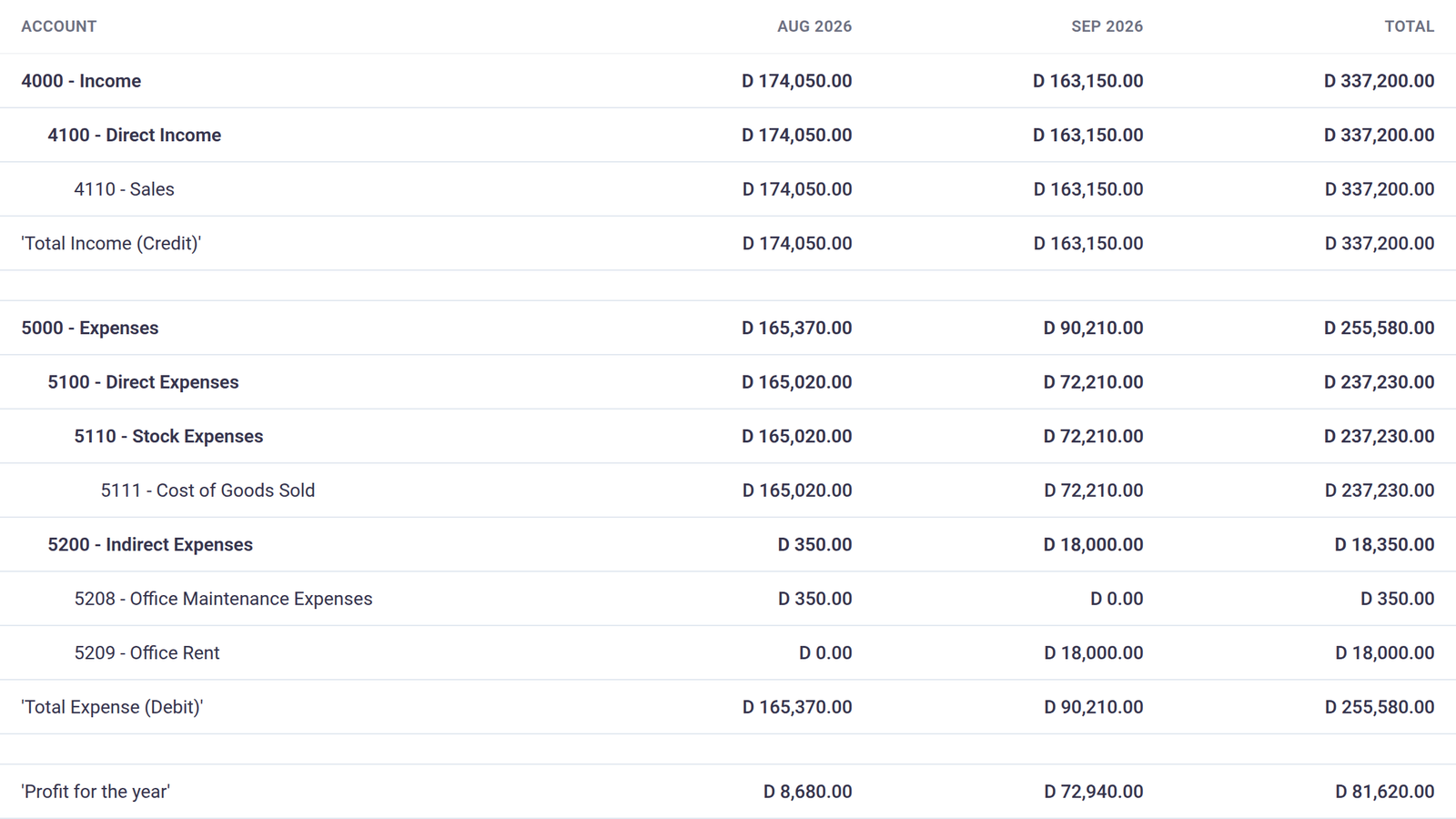
Look at the two months side by side. August made just GMD 8,680. September made GMD 72,940. Taken on its own, August looks like a bad month. It was not. August is when the workshop bought most of its timber and foam, and September is when that timber went out of the door as dining tables and sofas.
That is exactly the kind of thing an owner needs to see while it can still shape a decision, such as when to buy materials, whether a slow month is genuinely slow, or whether there is room to take on a second carpenter. Seen for the first time in a year-end total, it is just a number.
A routine that keeps you current
Staying current does not take a bookkeeper. It takes a small habit:
- Every sale: raise the invoice at the counter, not later.
- Every payment: record it against its invoice when it arrives.
- Once a week: import the bank statement, press Auto-Reconcile, and clear whatever is left over.
The weekly step is the one that matters most, and for a business the size of Kombo Furniture it takes about twenty minutes on a Friday afternoon. Anything that did not match is something you would otherwise have discovered months from now, if at all.
Your accountant does not become unnecessary. Their year-end work becomes a review of books that are already right, rather than a week of rebuilding them from receipts.
Getting started
Everything above is in Jokoor Books: invoices, payments, supplier bills, bank reconciliation with statement import and auto-matching, and reports that are correct on the day you open them. You can start on the free plan and see the pricing for larger teams on the pricing page. If you would rather have someone walk you through it, call us on +220 2023700.